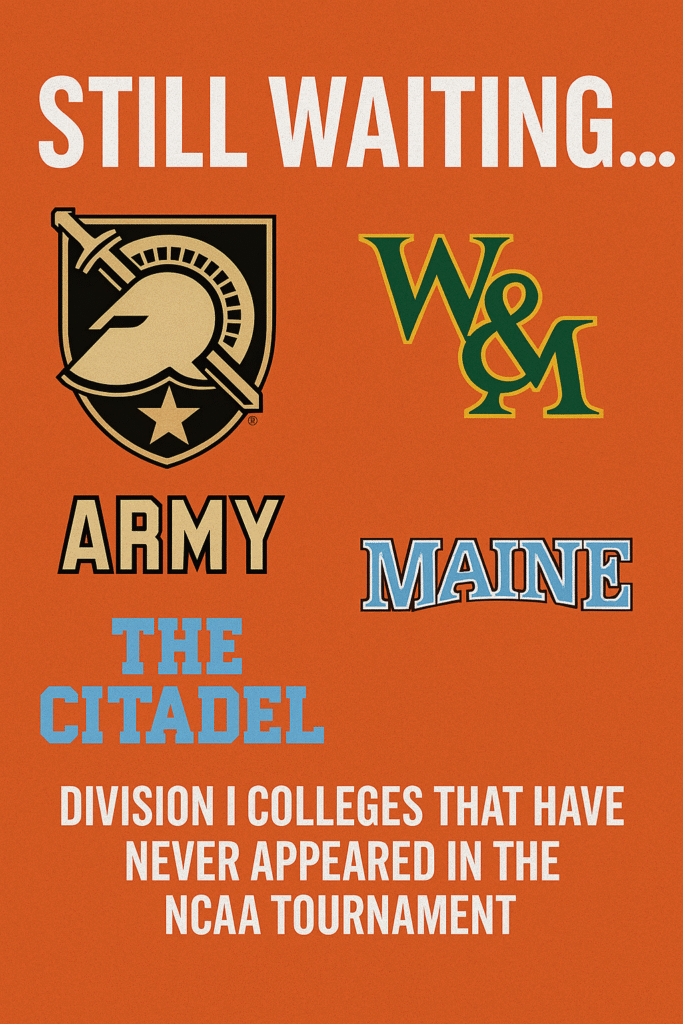
For decades, the NCAA Division I level has been the pinnacle of college athletics. The March Madness tournament, in particular, defines much of the excitement and prestige surrounding Division I basketball. But here’s the question: if a school has never appeared in the NCAA tournament, should it stay in Division I?
The Case for Forcing a Drop
Some argue that Division I should only include programs that are truly competitive on the national stage:
- Maintaining standards: D1 is meant to showcase the best of the best. A program with no appearances could be seen as falling short of that standard.
- Financial realities: Competing at this level demands millions in athletic spending. If a program can’t achieve results, those dollars may be wasted.
- Fan and recruiting interest: Perennial losing makes it harder to attract talent or keep alumni and local communities engaged.
Schools That Have Never Made It
There are several long-standing Division I programs that have never reached the NCAA tournament:
- Army (West Point) – Despite producing legendary coaches like Bob Knight and Mike Krzyzewski as players, they’ve never danced.
- The Citadel – Competing at the D1 level for over a century without a March Madness appearance.
- William & Mary – One of the oldest basketball programs in the nation, but still searching for its first bid.
- Maine – A D1 mainstay, but yet to break through in basketball.
- St. Francis Brooklyn – Competed for decades without a berth before shutting down athletics in 2023.
- Others, like Youngstown State, also remain part of the so-called “Never Made It Club.”
These examples show it’s not just small or underfunded schools — some historic institutions have never reached March Madness.
Why Forcing a Drop Doesn’t Work
On the other hand, the NCAA has never operated as a “survival of the fittest” league where weak programs are cut:
- Different goals: Some schools value the student-athlete experience, academics, or regional competition over national titles.
- Conference stability: Conferences need a full roster of teams. Booting weaker schools would destabilize entire leagues.
- Athlete opportunities: Competing in Division I — even without March Madness — still gives athletes exposure and high-level competition.
- History shows surprises: Schools like UMBC, which shocked the world as a 16-seed in 2018, remind us that underdogs can make history.
A Better Way Forward
Instead of forcing schools out, the better conversation is whether some institutions should choose to step down for sustainability. Programs like St. Francis College have already made that choice, while others may one day follow suit to balance budgets and competitiveness.
Final Word
While it may be tempting to say “if you never made the NCAA tournament, you don’t belong in D1,” the truth is far more complex. Division I isn’t just about championships — it’s about opportunities, identity, and the unique culture of college sports.